
PALPABLE’s Innovative Membrane for Precise Stiffness Detection in MIS
PALPABLE researchers have achieved a significant breakthrough in tactile sensing technology for minimally invasive surgery (MIS). Researchers Zhenyu Zhang, Martin Angelmahr, Ahmad Abdalwareth and Wolfgang Schade from Fraunhofer Heinrich Hertz Institute, Abu Bakar Dawood and Kaspar Althoefer from Queen Mary University of London and Georgios Violakis and Panagiotis Polygerinos from Hellenic Mediterranean University have successfully created a novel palpation probe that can detect tissue stiffness using fiber Bragg gratings (FBGs).
The multinational, multidisciplinary consortium members had the chance to get to know each other, present their organisations, institutions and companies and work. Additionally, initial technical planning, discussion of the following steps as well as the focal project points.
Innovative Fiber Optic Technology
The newly developed sensor utilises FBGs – periodic variations in the refractive index of an optical fiber core – inscribed point-by-point with femtosecond laser. These FBGs are integrated into a pneumatically actuated silicone membrane positioned at the tip of a 15mm diameter palpation probe, compatible with standard trocar ports used in MIS procedures.
FBG sensors are strategically positioned at the probe tip, enabling the system to not only detect the force applied to tissue but also precisely localize where that force is being applied. This spatial awareness is crucial for surgeons performing delicate procedures.
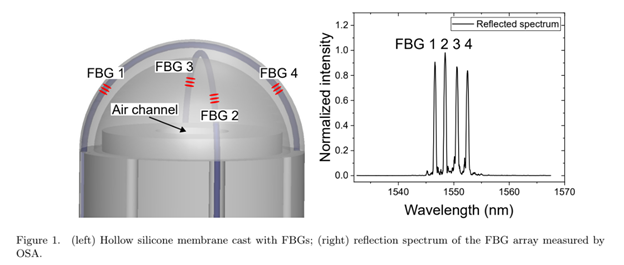
Remarkable Sensitivity
The system shows exceptional sensitivity, capable of detecting forces as small as 0.01N, with a working range of up to 2N. This high-precision sensing capability will help surgeons detect subtle differences in tissue characteristics.
This innovative technology represents a significant step toward bringing enhanced tactile sensing to minimally invasive surgery.
Mimicking the Sense of Touch
One of the most significant limitations in current MIS procedures is the loss of tactile feedback that surgeons would typically rely on during open surgery. The PALPABLE sensor aims to restore this crucial sensory input by providing real-time data on tissue characteristics.
The pneumatic membrane design offers a particularly innovative feature: by adjusting the air pressure within the membrane, the system can modify its sensitivity range. This allows the sensor to adapt to different tissue types and stiffness levels, much like how a surgeon might vary finger pressure during manual palpation.
Detecting Cancer Through Tissue Stiffness
The research demonstrates that the sensor can effectively distinguish between materials of different stiffness levels. In tests using silicone samples of varying shore hardness (similar to how tumors might feel firmer than surrounding tissue), the system showed clear differences in wavelength shifts when contacting softer versus harder materials.
This sensor is an integral component of the PALPABLE tool, which aims to enable surgeons to identify cancerous tissues during MIS by detecting variations in tissue stiffness.
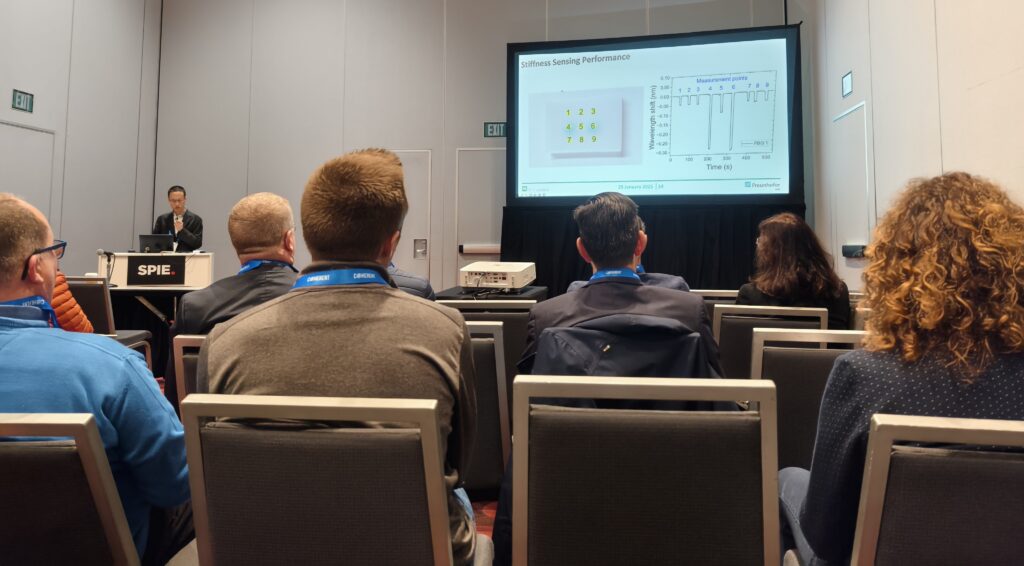
The research was presented at SPIE Photonics West 2025 by Z. Zhang and won the Best Presentation Award for Medical Diagnostics, Treatment, and Environmental Applications.
For those with access to the SPIE digital library you can read the full paper here.